
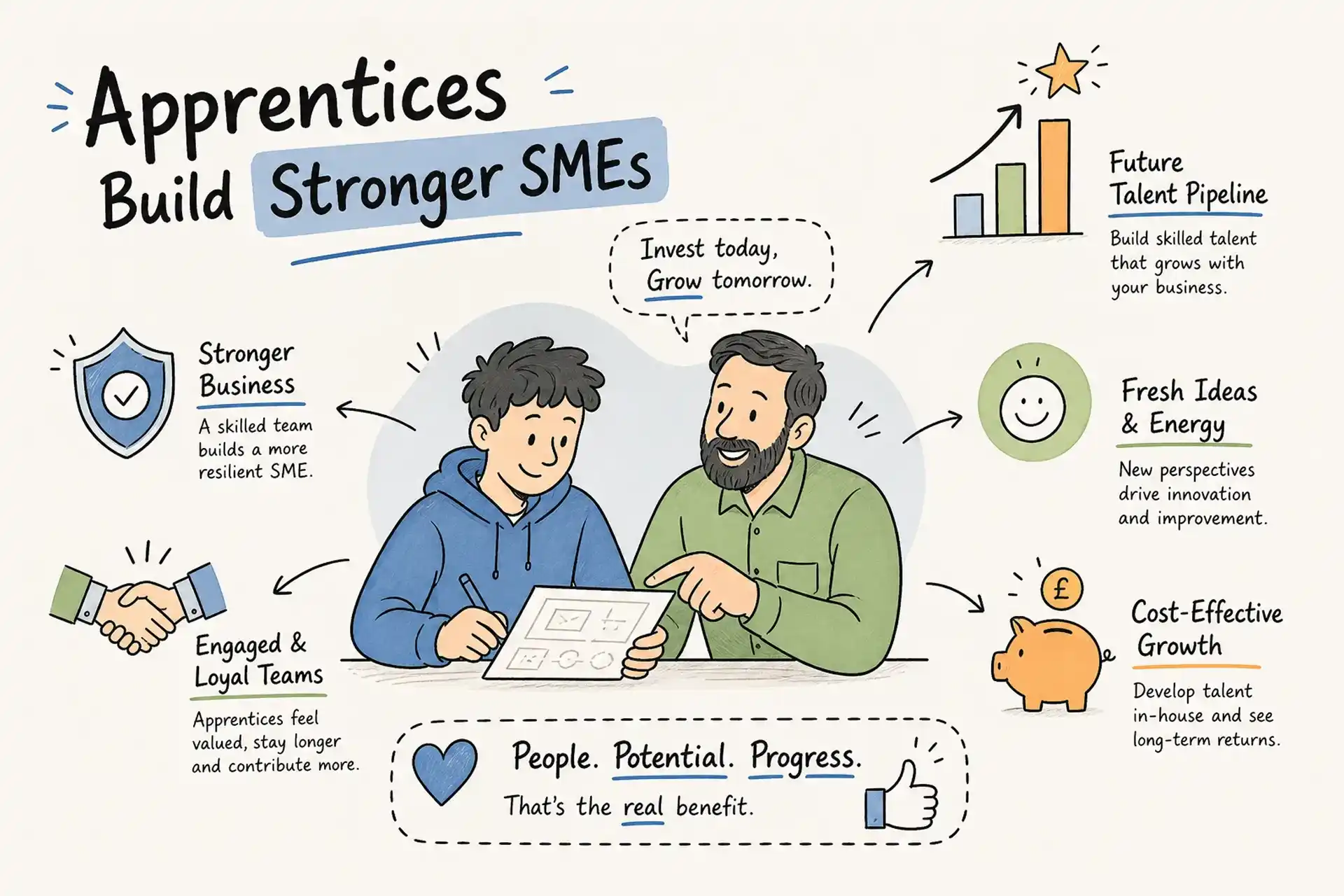
The benefits of taking on an apprentice for SME employers in Scotland are often misunderstood, or, more accurately, they are understood in outline but never acted upon. Many SME owners say they are aware that apprenticeships are a good idea. They nod along at business events, pick up the leaflets, and then do nothing. Not because they are opposed to the idea, but because the questions stack up fast: what does this actually cost me, what do I get in return, and how much of my week is this going to eat? Those are fair questions, and they deserve straight answers rather than government brochure language.
Training providers like us work with SME employers across Scotland, supporting businesses through framework selection, SDS administration, and ongoing assessor contact. What we have found is that the pattern is consistent: most come to us sceptical and cautious, and nearly all come away wishing they had started sooner. The funding is more generous than they expected, the admin is more manageable than they feared, and the return on a well-supported apprentice is tangible. What follows is the honest case for taking on an apprentice as an SME employer in Scotland, covering the real costs, the funding picture, the productivity evidence, the retention data, and exactly how to get started.
Before you can weigh up the benefits of taking on an apprentice for SME employers, you need a clear picture of the outgoings. There are three main cost areas, and none of them should come as a shock if you understand them upfront.
Your apprentice is a paid employee from day one. According to the National Minimum Wage rates effective from April 2026, the apprentice minimum wage is £8.00 per hour. This applies to apprentices under 19, or to those aged 19 and over who are in their first year. Once an apprentice moves past that first year and is aged 19 or over, they step up to the age-appropriate National Minimum Wage: £10.85 per hour for those aged 18 to 20, and £12.71 per hour for those aged 21 and above.
Some Scottish employers pay above the legal minimum to attract motivated candidates, which is worth factoring into your planning. Some SME owners find the initial period the trickiest adjustment, but wages are a predictable, plannable commitment rather than a surprise one.
On top of wages, apprentices must spend a minimum of 20% of their paid working hours in structured off-the-job training, as set out in SDS and UK government guidance on Modern Apprenticeship delivery. For a full-time apprentice, that works out to roughly one day a week where they are not carrying out normal duties. Their wages still run during that time.
The third cost is the one most employers overlook: mentoring time. A line manager or designated colleague will typically spend several hours each week supporting the apprentice, liaising with the training provider, and checking on progress. This is not a bureaucratic burden if the right provider is alongside you, but it is real time, and it belongs in your cost calculation. Frame it correctly, though: this is the time that shapes the quality of the team member you end up with.2
This is where the picture changes sharply. Scotland’s funding model for Modern Apprenticeships operates through Skills Development Scotland (SDS) and is meaningfully different from the England arrangement. In England, non-levy employers typically co-invest 5% of training costs. In Scotland, SDS contributes directly to training and assessment costs for Modern Apprentices. For many smaller employers, particularly those taking on younger apprentices, the training element costs nothing, although SDS contributions do vary by age, framework, and sector, so it is worth checking the SDS Modern Apprenticeship Contribution Table for the specific framework you are considering.
The SDS contribution ranges from £300 to over £10,000 per apprentice over the training period, paid directly to the approved training provider. As an employer, you are not managing complex accounts or navigating a digital training fund. You work with an SDS-approved provider, and the funding flows through them.
There are also targeted incentive payments worth knowing about. The Ethnic Intersectionality Incentive and the New Scots Incentive each provide an additional £1,000 per eligible apprentice, channelled through the training provider, for starts between April 2026 and March 2027, as set out in the SDS Modern Apprenticeship Programme Specification for the current funding year. It is worth checking current SDS guidance or speaking directly with your training provider as eligibility conditions apply to each of these incentives, and they change year to year.
The vast majority of Scottish SMEs sit below the £3 million annual pay bill threshold that triggers the apprenticeship levy. While the apprenticeship levy is a UK-wide charge on qualifying employers, Scottish employers typically access Modern Apprenticeship funding through Skills Development Scotland rather than through the English apprenticeship service. As a Scottish SME, your funding route runs through SDS, not through a levy account, and the process is considerably more manageable. An approved provider handles the framework selection, funding application, and reporting on your behalf.
No honest person will tell you an apprentice hits the ground running. The first few months are an investment phase: the apprentice is learning your systems, your standards, and the realities of the role. Productivity starts below that of an experienced hire and builds steadily. If you go in expecting a fully formed team member in week two, you will be disappointed. If you go in understanding that you are building something over a 12-to-24-month window, the numbers make a compelling case.
UK employer research, including studies by the Centre for Economics and Business Research (CEBR) and analysis cited in UK government apprenticeship factsheets, puts the average annual net benefit to employers during the apprenticeship training period at approximately £1,670 to £2,496 per apprentice. Broader estimates of annual gross output gains range from £2,500 to £18,000, depending on sector and level. Sector-level weekly productivity gains have been measured as follows:
These are averages drawn from UK-wide studies, not guaranteed returns, but they give you a realistic ballpark rather than a vague promise.
The less quantifiable benefit is equally real. An apprentice learns your way of doing things from the start. They do not arrive carrying habits from a previous employer or expectations shaped by a completely different business culture. For an SME where culture and process matter, that is a meaningful advantage, one that employers consistently report but that no job advert can replicate.
Retention is the metric that turns a training cost into a long-term asset. UK employer surveys, including data from the Employer Skills Survey and St Martin’s Group research, consistently show that between 60% and 73% of employers retain apprentice completers after programme end, with some studies recording higher figures for apprentices trained from existing staff rather than new external recruits. Smaller firms tend to see slightly lower retention than larger ones, which is worth acknowledging honestly. A small business cannot always offer the same progression pathways as a large organisation.
What those figures also show, however, is that apprentices trained from your existing workforce show stronger loyalty than those recruited specifically as apprentices. If you have staff who have grown into their roles without formal recognition, a Modern Apprenticeship in Scotland gives them a funded route to a recognised qualification and a clear signal that the business is invested in them. That translates directly into retention, engagement, and reduced recruitment spend.
Beyond individual retention, there is a structural argument for SMEs that struggle with skills shortages. Hiring from an unpredictable and competitive external labour market is expensive and often frustrating. An SME that builds a consistent pipeline of trained people, in the skills the business actually needs, reduces that dependency over time. Apprenticeships are not a short-term fix; they are a workforce development strategy that compounds in value.
The practical process is more manageable than most SME owners assume, particularly in Scotland where the funding model does not require employers to manage levy accounts or navigate complex digital funding systems. The first step is choosing the right Modern Apprenticeship framework for the role. These are frameworks approved by sector skills bodies and funded by SDS, spanning industries from early years and childcare to business administration. A good training provider will match the framework to the role, you should not need to interpret programme specifications on your own.
Your core responsibilities as an employer are clear: provide a real job with a proper employment contract, give the apprentice genuine work experience, support the 20% off-the-job training requirement, and maintain regular contact with the training provider. These are manageable commitments for any SME that approaches the process with some structure. The complexity comes when employers try to manage the compliance and reporting elements without support, which is where things can become unnecessarily burdensome.
Before naming a provider, it is worth noting that working with an SDS-approved training organisation is the key step. The right provider removes the administrative weight from your plate entirely and gives you a direct, named contact throughout the apprenticeship.
ESSOR Training works specifically with employers in Scotland. As an SDS-approved provider, we handle the administration, framework selection, and funding processes, and we provide dedicated assessor support throughout, so you always have a direct point of contact who knows your apprentice and your business. You do not need to become an expert in apprenticeship compliance to benefit from the programme. You need a provider who already is one. If you are ready to find out whether a Modern Apprenticeship is the right fit for your business, get in touch with our team and we will give you a straight assessment.
In short, the benefits of taking on an apprentice for SME employers include funded training, documented productivity gains, and stronger workforce retention, and the process in Scotland is considerably less complex than many owners assume. The funding is real, the productivity returns are supported by UK employer evidence, and the workforce development benefits are meaningful for any SME thinking beyond the immediate hire. The main barrier for most Scottish SME owners is awareness and perceived complexity rather than actual cost, though it is fair to acknowledge that time, capacity, and available progression pathways also play a role for smaller businesses.
Taking on an apprentice through a provider that understands the Scottish system, the SDS funding routes, and the sector-specific requirements makes the whole process considerably less daunting. The employers we work with at ESSOR Training are not managing the administrative side of apprenticeships themselves. They are focused on their business, while we manage the programme around them. That is the arrangement that works, and it is the one available to you. Stop filing this away as something to revisit later, and take the first step.
Others |
|
| Other uncategorized cookies are those that are being analyzed and have not been classified into a category as yet. | |
Necessary |
Necessary |
| Necessary cookies are absolutely essential for the website to function properly. These cookies ensure basic functionalities and security features of the website, anonymously. | |
Advertisement |
|
| Advertisement cookies are used to provide visitors with relevant ads and marketing campaigns. These cookies track visitors across websites and collect information to provide customized ads. | |
Analytics |
|
| Analytical cookies are used to understand how visitors interact with the website. These cookies help provide information on metrics the number of visitors, bounce rate, traffic source, etc. | |
Functional |
|
| Functional cookies help to perform certain functionalities like sharing the content of the website on social media platforms, collect feedbacks, and other third-party features. | |
Performance |
|
| Performance cookies are used to understand and analyze the key performance indexes of the website which helps in delivering a better user experience for the visitors. | |
This website uses cookies to improve your experience while you navigate through the website. Out of these, the cookies that are categorized as necessary are stored on your browser as they are essential for the working of basic functionalities of the website. We also use third-party cookies that help us analyze and understand how you use this website. These cookies will be stored in your browser only with your consent. You also have the option to opt-out of these cookies.